Spring Equinox

It’s that time of year again! We’re all tired of winter’s cold weather, along with the snow, ice, wind, and grey skies.  We are hungry for warmer weather.  We can see the lengthening of daylight but are still looking for ‘green’. When the calendar flips to March, we can finally see signs of hope as the spring equinox is near.

Also known as the vernal equinox, March 20, 2025 at 5:01AM EDT marks the beginning of spring in the Northern Hemisphere.  It occurs when the Earth’s axis is perpendicular to the sun and the sun shines directly on the equator.  This results in days and nights that are equal in length. 

Solstices, on the other hand, represent times when the Earth’s axis reaches its maximum tilt towards or away from the sun — when days and nights are the longest or the shortest. For the last few years, Catskill has held a Solstice Stroll in December and is working on creating a similar event this June.

After the spring equinox, the Northern Hemisphere tilts toward the sun, resulting in gradually longer days and warmer temperatures. The reverse is true in the Southern Hemisphere.

The start of spring is a cause for celebration.  Many holidays occur in early spring such as Easter, Passover, Holi, among others. The season means warmer weather so many celebrate by spending time in nature, (re)decorating their homes, or engaging in spring sports such as baseball or track and field events. The vernal equinox also marks the start of the zodiac calendar. This seasonal cycle of the year is created by the Earth’s annual orbit around the sun.

It’s a time for both worldly and personal renewal – a fresh start! Enjoy the feel of the returning sun. Listen closely for the songbirds return and their songs as the earth reawakens and warms. As the rivers and streams rise from the melting snow, we often feel the need to re-awaken our spirits and wash away the physical and mental debris that has gathered over the winter.  The thaw has come.  It’s time for spring cleaning to open the blinds, wash the windows, dust the cobwebs, and shake out the rugs. In springtime, we feel the determination of a daffodil growing through the soil to reach the sun. The old melts away with the snow.  New ideas, plans, dreams, and possibilities sprout, needing our attention. A brand-new world of growth awaits!

Many people celebrate the spring equinox by waking up with the sun, to awaken the mind and body for a new day and season. Others use the vernal equinox to plant seeds for this year’s garden. But note that we cannot really hasten the garden’s growth. Like the earth, we must stay balanced between the open anticipation of what spring will bring and the patience to wait for the soil to warm up to allow plants to flourish.

However you mark the occasion, I hope you find this month to be a time for reflection, growth and new beginnings.  There’s no time like the present to get outside and celebrate the return of warmer weather. Happy Spring!
The wonders of water

“A garden requires patient labor and attention. Plants do not grow merely to satisfy ambitions or to fulfill good intentions. They thrive because someone expended effort on them.” — Liberty Hyde Bailey

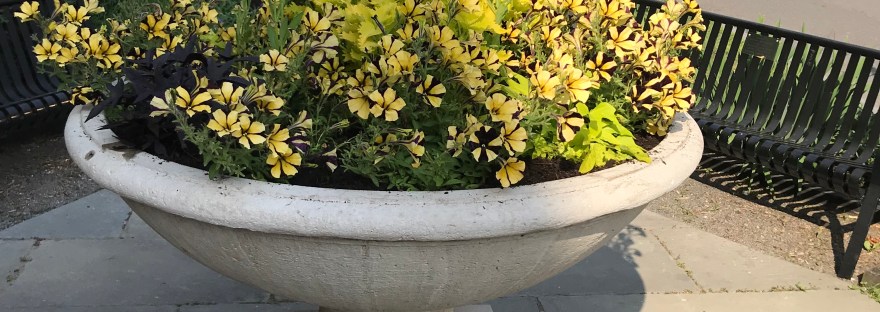
A special “thank you” to all the Cultivate Catskill volunteers who have spent countless hours planting, deadheading, weeding, mulching and watering the flowers around town. And an extra special “thanks” to the DPW workers who water the hanging baskets and pots along Main Street, a well as the Greene County workers who cut the grass in our parks.

As I was watering Leggio Park this morning, I had a chance to contemplate the wonders of water. Did you know that water covers 71 percent of the Earth’s surface and is vital to all known forms of life? It is a transparent, tasteless, odorless and nearly colorless chemical substance that is the main constituent of the Earth’s streams, lakes and oceans. It is also the fluid of most living organisms, including plants.

Like all life on Earth, plants need water to survive and grow. Indeed, like humans, water is the primary element that makes up the structure of plants. Human bodies are comprised of about 70 percent water, but in plants, this proportion can be as high as 95 percent. In plants, water is used for structure, photosynthesis, translocation and transportation.

Water helps plants move nutrients from the soil through its stems and leaves. It also keeps the plant moist, flexible, and helps the plant make its own food. Photosynthesis is what plants do to create their food and water is critical to this process. Water enters a plant’s stem (via the roots), and travels up to its leaves where photosynthesis takes place. Once in the leaves, water evaporates, as the plant exchanges water for carbon dioxide. The combination of sunlight, healthy soil, clean air, and water all work together to help keep a plant healthy.

So what’s the best way to water? One key is to focus on the root zone … not the leaves. Wetting the foliage is a waste of water and can promote the spread of disease. Also, remember to water only when needed. Too much water can be just as damaging to plants as too little. Make sure to water deeply and thoroughly. Lawns and annuals concentrate their roots in the top six inches of the soil. For perennials and shrubs, it’s the top 12 inches. Water in the morning to allow any moisture on the leaves to dry out. And to conserve water evaporation in the soil, mulch everything.

In Catskill, we are most fortunate to be surrounded by water in our lakes, streams. creeks and of course the Hudson River. But while 96.5 percent of our plant’s water supply is found in seas and oceans, only 1.77 percent is in groundwater. (The rest can be found in glaciers, ice caps in Antarctica and Greenland and a very small amount in vapor, clouds and precipitation.

The current dry spell is a reminder to conserve our drinking water and appreciate the life sustaining properties of this vital fluid. Consider installing a rain barrel to water your flower garden. Also, keep trash away from and out of our waterways to help ensure the beauty and viability of our ecosystem. Being cognizant of the role water plays in our environment, you can help us continue to Cultivate Catskill.

Catskill Roadside Cleanup

Have you noticed how much litter has accumulated along our local Catskill roadsides over the winter?  As you drive around the area, do you notice all the discarded bottles, cans, cups and paper in the gullies along our roadways?  Trash detracts from the beauty of our community and harms the enviroment.  Now you can help do something about it!

Earth Day is an annual event that is held to demonstrate support for environmental protection.  Join Cultivate Catskill and the Fortnightly Club by participating in our first annual Catskill Roadside Cleanup.  Volunteers will walk along our local roadways to pick up and bag roadside trash.  Do your part for Earth Day and restore the beauty of our local landscapes!

The Details

Pick up trash bags at your local firehouse between 9AM and 11AM on April 21st, rain or shine.  Please bring your own gloves.  Water and a vest will be provided.  You will be asked to sign a volunteer relase form.  Select which street you’d like to work on or we’ll assign a roadway that needs your attention.

Carefully walk along the roadway and put trash in the bags provided.  Leave full bags on the shoulder of the roadway to be picked up.  The Town of Catskill Highway Department and the VIllage of Catskill Department of Public Works will help us by collecting the bags.

Thank you for helping our community and the earth!